Health literacy is a major determinant of health. The World Health Organization (WHO) defines health literacy as the “cognitive and social skills that determine an individual’s motivation and ability to access, understand, and use information to promote and maintain good health”. In this context, cancer literacy refers to all the knowledge a layperson needs to possess to understand the information and advice the health system provides concerning cancer prevention, diagnosis, and treatment. Understanding and improving cancer prevention literacy is a key component of public health strategies aimed at reducing cancer incidence and promoting health equity.
Under the World Code Against Cancer Framework, the concept of cancer prevention literacy is used as a unifying umbrella term encompassing interrelated constructs drawn from several behavioural change theories and models, i.e. the Integrative Model of Behavioural Prediction, the Health Behaviour Model, the Preventive Health Care Behaviour Model, and the Tripartite Model of Risk Perception (TRIRISK).
Building on existing cancer prevention awareness questionnaires, a comprehensive questionnaire for adults in the general population has been developed and validated: the Cancer Prevention Literacy Questionnaire (CPL-Q). The main purpose of the CPL-Q is to monitor and evaluate the dissemination of Regional Codes Against Cancer over time, in regions where such a Code exists, while measuring (1) cognitive-attitudinal or proximal factors impacting cancer prevention literacy (i.e. beliefs about cancer, risk perception, awareness about cancer prevention, knowledge of cancer prevention and risk factors, and intention to change behaviours) and (2) literacy-enacted or distal factors (i.e. adherence to behaviours), through which educational exposure is theorized to produce or maintain behavioural change.
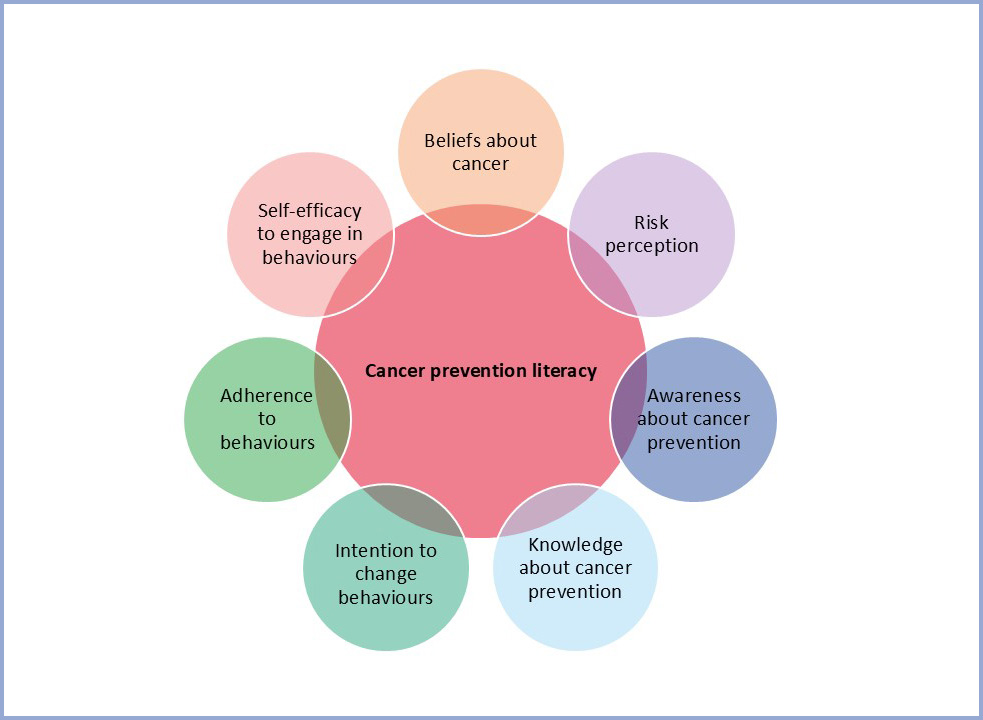
The Cancer Prevention Literacy Questionnaire (CPL-Q) and related materials:
This section provides access to a set of materials developed to support research across different regions. These include questionnaires, guidance documents, methodological resources, and other tools designed to facilitate their appropriate use in diverse contexts. The following documents are available:
- [PLEASE READ ME] Guide on how to use the Cancer Prevention Literacy Questionnaire (CPL-Q), including the validated CPL-Q as an Annex, and supporting materials
- The adapted CPL-Q for the 5th edition of the European Code Against Cancer (in English)
- The adapted CPL-Q for the 1st edition of the Latin America and the Caribbean Code Against Cancer:
- Methodological peer-reviewed publication
- Extended database including additional questions on constructs related to cancer prevention literacy.
How to cite
Adapted from Feliu A, Islam R, Romeo-Cervera P, Bouaoun L, Whitelock V, Pirvan M, et al. (2026). Cancer Prevention Literacy Questionnaire (CPL-Q): development and validation within the World Code Against Cancer Framework. BMC Public Health. 26(1):1052. https://doi.org/10.1186/s12889-026-26641-9 PMID:41731412
Acknowledgements
We would like to thank Silvina Arrossi, Centro de Estudios de Estado y Sociedad, Argentina; Fernanda de Albuquerque Melo Nogueira, Instituto Nacional de Câncer (INCA), Brazil; Catterina Fereccio, Pontificia Universidad Católica de Chile, Chile; Carolyn Finck, Universidad de Los Andes, Colombia; Patricia J. Garcia, Universidad Cayetano Heredia, Peru; Marius Geantă, INOMED, Romania; Rolando Herrero, Agencia Costarricense de Investigaciones Biomédicas, Costa Rica; Mariantonia Lemos, Universidad EAFIT, Colombia; Ana Molina, FISABIO, Spain; Raúl Murillo, Pontificia Universidad Javeriana, Colombia; Dafina Petrova, Escuela Andaluza de Salud Pública, Spain; Marina Pinto, FISABIO, Spain; Ana Santos, Universidade de Aveiro, Portugal; Mafalda Uva, Instituto Nacional de Saúde Doutor Ricardo Jorge, Portugal; and Loredana Vlado, Eurocomunicare, Romania for their participation in the Delphi study as panellists; and Tilman Brand, Leibniz Institute for Prevention Research and Epidemiology - BIPS, Germany; Erica D’Souza, IARC, France; Isabel Garcés, Universidad de Antioquia, Colombia; Kate Hamilton-West, Cancer Research UK, United Kingdom; Isabel Mosquera, IARC, France; Kimberley Neve, Cancer Research UK, United Kingdom; Sathishrajaa Palaniraja, IARC, France; David Ritchie, IARC, France; Stephan Van den Broucke, Université catholique de Louvain, Belgium; and Hajo Zeeb, Leibniz Institute for Prevention Research and Epidemiology - BIPS, Germany for their input in the face-validity assessment.